
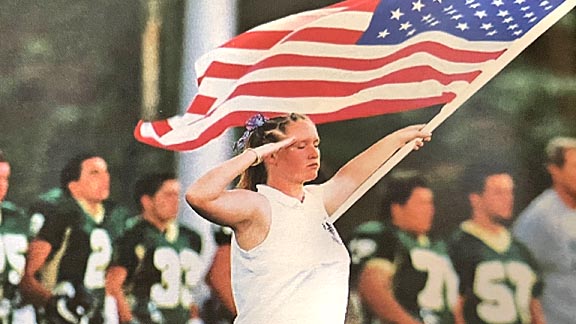
Flag girl from Mira Costa High of Manhattan Beach stands proud during national anthem played at first football game played at her school since the events of Sept. 11, 2001. Photo: Ray Vidal / Student Sports.
High school football teams on that horrible week 25 years ago today adapted and reflected and many of them will never forget what happened since several of them had former players who were killed. We take a look back through magazine articles we edited that year for Student Sports Magazine. We had a writer at one game between Peninsula of Rolling Hills Estates and Bishop Amat of La Puente. We talked to school officials who didn’t know whether to play games that Friday after the Tuesday attacks and since then we’ve looked up information about a lot of others involved.
We hope you enjoy this free post on CalHiSports.com. All regular season State TOP 50 rankings will be Gold Club posts. All of our exclusive state record lists also are for Gold Club only plus state record & state stat stars featurs. We are in our 48th season of covering California high school football. You can sign up today to get all of our Gold Club content right now for $4.99 per month, $12.99 for three months or $24.99 for one year. For details, CLICK HERE.
Editor’s note: Current Line Drive Media softball editor and owner Brentt Eads also was part of Student Sports Magazine 25 years ago and wrote the item below about a game he went to in Southern California that Friday.
The day the world was changed forever was Tuesday, Sept. 11, 2001. Terrorist attacks on New York and Washington D.C. (one of them was thwarted by passengers aboard a fourth jet that crashed into a field in Pennsylvania) first stung and surprised America, but ultimately it served as a unifying force.
After the first few days of initial shock began to wane, football games were scheduled to be played. A few schools in California played, most did not. Many took the lead of the NFL, which eventually decided not to have games on the Sunday following the Tuesday attacks. The pre-game playing of the National Anthem instantly had more meaning.
The following is a collection of short stories of reaction and response surrounding California high school football teams from that week and the following week.
IN MEMORY OF A FALLEN PANTHER
Sadly, the Southern California matchup between Peninsula of Rolling Hills Estates and Bishop Amat of La Puente held on Friday, Sept. 21 was similar to hundreds held across the nation that night: It featured a moment of silence in respect to an alum who perished in the terrorist attacks of nine days before.
Chris Larrabee was a 26-year-old former football player at Peninsula, Class of 1993, who worked on the 104th floor of the World Trade Center’s North Tower and was killed when hijackers crashed an American Airlines plane into the building.
At the football game, the American flag flew at half-mast. Fifteen minutes before the start of the contest, a small school choir sang “God Bless America,” “America, the Beautiful” and “The Star Spangled Banner.” The Panther players wore two decals on the back of their helmets: one bearing an American flag and the other with the initials “CL.”
In the stands, fans wore flag pins and clothing with patriotic symbols and/or colors. Yells for the teams often gave way to quiet introspection during lulls in on-field action. Throughout the game, a 30-7 dominating win by Amat, administrators and friends reflected on the loss of the former Peninsula player that made the tragedy 3,000 miles away seem much more close and personal.
“It’s very simple,” athletic director John Barr said solemnly, “this was a terrible loss for everyone in the Panther family.”
“This senseless loss makes the horror in New York seem very real for our school and community,” stated principal Kelly Johnson. “I remember Chris played football his junior year and then missed a lot of time his senior year with a major illness. He couldn’t play football and had to struggle to get through school, but he did and went on to Arizona and was doing great with his whole life ahead of him.”
Blake Paulin, a star tight end at Peninsula during the 1995 season, remembered his interactions with Larrabee.
“Chris was outgoing and always upbeat,” Paulin said. “He knew what he wanted in life. We talked all the time, mostly about surfing and football. His death makes me realize football isn’t the most important thing in my life.”
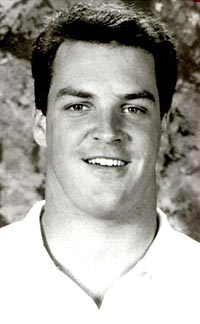
This is the late Brent Woodall from La Jolla High and the University of California Berkeley, a football player, baseball player who died during 9/11 terror attacks. Photo: woodallforkids.com.
IN MEMORY OF A FALLEN VIKING
There has been a lot of details reported over the years about the loss of one of the greatest athletes in La Jolla High’s history, Brent Woodall, on September 11. Woodall, who was the San Diego Union-Tribune Athlete of the Year for the 1987-88 school year, played both football and basketball at Cal and pitched professionally for the Chicago Cubs before his baseball career was ended due to injury. He then became an equities trader and stock broker and was working on the 89th floor of the World Trade Center’s South Tower.
The 31-year-old at the time, according to an article published in 2006 by the Voice of San Diego, called his parents after the first plane struck the North Tower to tell them he was okay. He called again after the second plane hit the South Tower that he was looking to get out. Woodall’s final call was to his then pregnant wife, Tracy, that he was trapped with others trying to get to a stairwell. The South Tower collapsed not long after that call. The North Tower, which was struck first, collapsed 29 minutes later. Woodall was one of 2,606 people who were killed in the two towers on that morning.
Dave Ponsford, a football coach at La Jolla when Woodall played there, told the San Diego Voice five years later that he believed the former three-sport standout would have wanted the games to be played. La Jolla High was one of the few that did on the following Friday.
“There is no doubt in my mind that Brent would have wanted us to play that game,” Ponsford said. “Brent was a focused and tenacious player. I think he would have been upset that terrorists had been able to disrupt our society. He wouldn’t want us to give in to them.”
TO PLAY OR NOT TO PLAY?
A random sampling of schools with top-ranked football teams in California conducted on the early afternoon of Sept. 13 showed that only a small number of scheduled games for Friday night, Sept. 14, were going to be canceled or postponed in the aftermath of the terrorist attacks on New York and Washington D.C. earlier that week.
But by the end of that day, the number of those schools who were canceling or postponing was growing by the hour. Another sampling the next day seemed to indicate that many school districts decided to cancel after the NFL announced it was postponing all of its weekend games. President George W. Bush also had declared that Friday would be a National Day of Prayer and Remembrance.
The Fresno Unified School District met on Sept. 12 and announced all of its schools would be allowed to participate in athletic events during the weekend. That stance changed the next day.
“The reason we reversed our decision was out of consideration for the President’s proclamation,” said Carol Sarkisian-Bonard, assistant superintendent for secondary education, in a quote taken from the Fresno Bee. “We will have appropriate remembrances during the day at schools. To hold athletic events would not be a an appropriate remembrance.”
Nationwide, the best example of the ripple effect was in Oklahoma. After the NFL made its decision, all Division 1-A colleges postponed games, including Oklahoma and Oklahoma State, which originally were going to play. Those cancellations then prompted the state association to recommend that no high school games be played, either. That resulted in the cancellation of one of the nation’s top rivalry games between Tulsa-area powerhouses Jenks and Tulsa Union.

Thick, black smoke billows out from the World Trade Center’s two towers during the time span in between the jets being flown into them and their collapse. Photo: CBS News.
FLIGHT 93 HERO WAS FROM BAY AREA
& FORMER STAR QB IN MINNESOTA
Many of the victims on the planes that were used to hit the World Trade Center, Pentagon and that was headed to perhaps the White House or Capitol building in Washington D.C. were from California. The two that struck New York began on flights from Boston to LAX. The one that hit the Pentagon was from Washington D.C. to LAX while the one that crashed in Pennsylvania was from Newark N.J. to San Francisco.
Only three days after the attacks, Jefferson High in Bloomington, Minn., played its game and did so with great sadness and respect for Class of 1981 grad Tom Burnett Jr. He was the starting quarterback at Jefferson in 1980 and helped the team reach the state championship game in its division. He then went on to become a successful business executive in the San Francisco Bay Area. He was returning to his home in Danville and was on United Airlines Flight 93, which did not get used as a weapon against a building in Washington D.C. but did plummet nose first into a field, killing all aboard.
According to a free-lance writer (Scott Neuenfeldt) used by Student Sports Magazine that year, Tom Burnett Jr.’s dad, Tom Sr., went to the game at the field where his son had some of his greatest athletic moments.
At one time, Tom Jr. was part of the American ritual of high school football on a Friday night. The ritual is embedded deep into the fabric of the nation, so much so that Tom Sr. chose to attend a game just three days after his son died. A son who is now widely thought to have helped foil that fourth plane. Burnett Jr. made crucial phone calls to his wife, Deena, and realized along with others on the plane that it was on a suicide mission. He and other passengers, most famously himself, Todd Beamer of Washington and including former Cal rugby standout Mark Bingham, charged into the cockpit.
While most pro sports across the United States paused to mourn, high school football in many states continued. As Jefferson coach Jon Leverenz told the Minneapolis Star-Tribune: “I think it’s good for America to do this. Friday night means high school football. This shows America is still ticking on the inside.”
Tom Burnett Jr. and others on Flight 93 probably did what they felt was necessary. The terrorists were willing to die for their cause and may not have thought Americans would act as they did. They couldn’t have been more wrong.
We all owe Tom and the others on that plane a never-ending debt of gratitude and we will do our best to help the California high school football Friday night players of today to never forget.
Mark Tennis is the co-founder and publisher of CalHiSports.com. He can be reached at markjtennis@gmail.com. Don’t forget to follow Mark on the Cal-Hi Sports Twitter handle: @CalHiSports